


Stefan Benedetti, Senior Portfolio Manager Distressed, High Yield Debt, Plenisfer Investments SGR
In credit markets, a very high yield generally signals an equally high level of risk. But not all risks are the same. More importantly, market prices do not always accurately reflect the outlook for an issuer.
This distinction is particularly important in emerging markets, which include economies with very different fundamentals, financial systems and corporate structures. The distressed segment makes this diversity even more apparent.
When a company comes under financial pressure, the price of its bonds can fall sharply, reflecting expectations of default or restructuring. However, a lower bond price does not necessarily mean that the business has lost an equivalent share of its economic value.
A company may face liquidity constraints, refinancing challenges or operate in a country experiencing a crisis, while still retaining productive assets, revenues and cash-generating capacity. When assessing an investment opportunity, it is essential to determine whether these resources are sufficient to support the debt. Above all, investors need to assess whether their value can translate into recoveries for bondholders.
This is where the distinction between simple risk and a potential opportunity emerges. The key is not the headline yield, but the relationship between the price paid, the probability of loss and the potential recovery value.
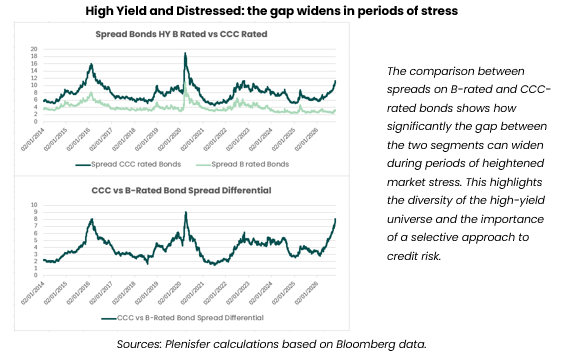
How risky is distressed credit?
Distressed credit is typically considered one of the riskiest asset classes in financial markets. But is this really the case?
In terms of volatility and potential loss of value, distressed credit is broadly comparable with equities. Unlike shareholders, however, bondholders have a defined position in the capital structure. In a restructuring or liquidation, they may be entitled to recover value ahead of shareholders, depending on the seniority of the bond and the available collateral.
This does not mean that recovery is guaranteed. Maturities may be extended, coupons reduced or suspended, and the principal amount of the debt may be written down. The key question is therefore how much value can realistically be recovered, rather than simply how much the bond price has fallen.
Recovery value: how much is a distressed bond worth?
In distressed credit, identifying potential opportunities necessarily requires a forward-looking approach. Historical financial statements and current ratings are not sufficient to assess what may happen in the future. The analysis starts with four key questions.
The first concerns the business. Does the company provide strategic products or services, or operate in areas with sustainable demand? Can it continue to operate and generate cash even under adverse conditions?
The second concerns governance. Is the company well managed? Companies accustomed to operating in complex countries often rely on highly experienced management teams. Without strong management, they may simply be unable to remain competitive. When this is combined with clear governance, the company may represent an opportunity worth considering.
The third concerns assets. Plants, infrastructure, concessions and other assets may support the economic value of a company. However, book value does not necessarily correspond to the value that can be recovered in a liquidation or restructuring. Investors need to consider asset liquidity, disposal costs, potential legal constraints and the time required to monetise these assets.
The fourth question concerns capital structure. Who has priority for repayment? Which debt is secured and which is subordinated? Which entities within the group are actually liable for the debt? We tend to favour markets in Latin America, Eastern Europe and Africa, where debt structures are relatively straightforward. In other markets, multiple layers of subordination can make the recovery process significantly more complex.
The outcome of this analysis is an estimate of recovery value, meaning the proportion of value that could potentially be recovered following a restructuring or default. For investors, this is a critical reference point. It becomes particularly relevant during periods of heightened geopolitical or financial uncertainty, when selling pressure can affect entire sectors or countries without adequately distinguishing between individual companies. In these situations, a bond price may reflect a very negative scenario before it becomes clear whether the company has actually lost its ability to generate cash and meet its obligations. Conversely, an apparently attractive bond may conceal a structurally impaired business model, assets that are difficult to monetise or a debt structure that leaves limited recovery value for certain creditors.
Emerging markets: opportunities between country risk and fundamental value
Latin America generally represents one of the broadest markets in which to identify opportunities in corporate credit, particularly in distressed situations. This reflects the depth of the bond market and the wide range of sectors and financial situations.
Opportunities in Latin America can emerge in very different areas, from oil companies in Mexico to energy businesses in Colombia and Argentina.
In Brazil, the recent election cycle has confirmed a highly polarised political environment, contributing to short-term uncertainty and volatility. At the same time, the strength of the institutional framework and the depth of financial markets continue to support our positive view on the country. Against this backdrop, periods of higher volatility can create price dislocations in distressed credit alongside opportunities in traditional credit. These need to be assessed selectively through fundamental analysis and an evaluation of potential recovery value.
Beyond Latin America, Ukraine is a distinct case. The war continues to affect the valuation of Ukrainian credit, but country risk does not necessarily provide a uniform picture across all companies. Some businesses have continued to operate, export, generate cash flows and meet their financial obligations despite the conflict. In such cases, market prices may incorporate a very high risk premium. This can potentially create a disconnect between bond prices and the operating capacity of the issuer.
Similar considerations apply to other emerging markets. In Senegal, fiscal pressures have increased concerns over a potential sovereign debt restructuring. The strategic importance of the country in West Africa could influence how any restructuring process develops, but the outcome cannot be taken for granted. For investors, the key is to assess which scenarios are already reflected in market prices and what level of recovery can reasonably be expected under each scenario.
Transport and energy: assets and cash flows make the difference
Geopolitical tensions can also create price dislocations in sectors exposed to shocks in costs and trade routes.
Airlines are one example. Higher fuel costs, weaker demand on certain routes and airspace restrictions linked to conflicts in the Middle East can put pressure on airlines and businesses across the aviation value chain. In this environment, aircraft leasing companies deserve particular attention. They own assets that may retain strategic value over the long term, even during periods of market stress. However, aircraft values cannot be viewed as an automatic guarantee of recovery. The type and age of the fleet, maintenance costs, the ability to redeploy aircraft to other operators and liquidity in the secondary market all need to be considered. For creditors, the key question is whether asset values and cash flows generated by leasing contracts are sufficient to support the debt.
In energy, opportunities may arise among selected oil services, refining and infrastructure companies in South America and East Africa. Investment across the energy value chain may benefit from the need to develop and diversify energy supply. However, not all companies benefit to the same extent. Contract quality, cost exposure, capital requirements and financial structure ultimately determine how much potential growth can translate into debt-servicing capacity.
Yield is the starting point, not the conclusion
In distressed credit, selectivity matters more than broad exposure to a sector or country. A double-digit yield can signal an opportunity, but it can also indicate a risk of permanent capital loss. The assessment must therefore compare the purchase price with potential recovery value. It should consider not only the amount that could ultimately be recovered, but also the time required and the uncertainty surrounding the recovery process.
It is also important to distinguish between financial distress and a structurally impaired business model. A company with valuable assets and credible operating prospects may experience financial pressure that requires a debt restructuring. By contrast, a company that no longer generates cash, or whose assets have suffered a structural loss of value, faces a much deeper problem. In some cases, restructuring can create the conditions to preserve value. In others, it simply transfers losses to creditors.
This is where bottom-up analysis becomes critical. Each issuer needs to be assessed on its fundamentals. The capital structure needs to be reconstructed and different recovery scenarios modelled. Investors should not rely solely on benchmarks or ratings, which may react with a lag to changes in credit risk. In distressed credit, the real advantage does not come from buying what has fallen the most. It comes from identifying situations in which the market is pricing a scenario that is more negative than fundamentals would suggest, and assessing whether the potential return adequately compensates for the risk of loss.
Disclaimer
This analysis relates to Plenisfer Investments SGR S.p.A. (“Plenisfer Investments”) and is not a marketing communication relating to a Fund, investment product or investment services in your country. This document does not constitute an offer or invitation to sell or purchase securities or any activity or business described herein and does not form the basis of any contract. Any opinions or forecasts provided are current as of the date specified, may change without notice, do not predict future results and do not constitute a recommendation or an offer of any investment product or service. Past performance does not predict future returns. There can be no guarantee that an investment objective will be achieved or that capital will be returned. This analysis is intended solely for professional investors in Italy within the meaning of Directive 2014/65/EU on markets in financial instruments (MiFID). It is not intended for retail investors or US Persons, as defined in Regulation S under the United States Securities Act of 1933, as amended. The information is provided by Plenisfer Investments, authorised as a UCITS management company in Italy and regulated by the Bank of Italy - Via Niccolò Machiavelli 4, Trieste, 34132, Italy - CM: 15404 - LEI: 984500E9CB9BBCE3E272. All data used in this analysis, unless otherwise indicated, is provided by Plenisfer Investments. This material and its contents may not be reproduced or distributed, in whole or in part, without the express written consent of Plenisfer Investments.
Plenisfer Investments SGR S.p.A.
Via Niccolò Machiavelli 4
34132 Trieste (TS)
Via Sant'Andrea 10/A, 20121 Milano (MI)
info@plenisfer.com
+39 02 0064 4000
Contact us at info@plenisfer.com

Tax ID: IT 01328320328
Belonging to Generali Italian VAT group: 01333550323
Registered to The National Compensation Fund
This is a marketing communication. Please refer to the Prospectus and Key Investor Information Document (KIID/KID) before making any final investment decisions. Past performance is no indication of future performance.
The value of your investment and the return on it can go down as well as up and, on redemption, you may receive less than you originally invested.
© Copyright Plenisfer Investments onwards 2020. Designed by Creative Bulls. All rights reserved.