


Marco Mencini, Head of Research, Plenisfer Investments SGR
For more than a decade, commodity markets have been interpreted through two lenses: demand and geopolitics. The former explained the outlook for consumption growth, while the latter accounted for supply shocks. The invasion of Ukraine, the attacks in the Red Sea and, more recently, the conflict between Israel and Iran have further reinforced this narrative, leading the market to view every new crisis as a potential trigger for a period of structural scarcity.
In recent months, however, a development has emerged that warrants a different interpretation. This is not because the international environment has become less unstable, but because the system’s ability to adapt to shocks has proved greater than the market had been prepared to acknowledge. Supply chains have been reorganised, new trade flows have replaced those that were disrupted and, in most cases, the most extreme scenarios have failed to materialise.
This does not mean that geopolitics has become irrelevant. Rather, it means that shocks tend primarily to affect short-term volatility, while the long-term outlook increasingly depends on structural factors. The central question no longer appears to be whether the world will run out of oil, copper or uranium. The question that investors and businesses should be asking is different: will the industrial system be able to increase supply at the same pace as demand for energy and raw materials grows?
For many years, the debate focused on the availability of natural resources. Today, the real limiting factor is the capacity to turn those resources into production. Developing a new oil field, opening a mine or increasing nuclear fuel production requires time, capital, expertise and an increasingly complex regulatory environment. After more than a decade of insufficient investment in new extraction sites, rebuilding the industrial base represents a very different challenge from simply exploiting existing resources.
This transformation also coincides with an equally profound shift in the global growth model. For many years, it was assumed that digitalisation would progressively reduce the importance of physical assets, fostering an increasingly intangible economy. The spread of artificial intelligence is instead revealing the opposite phenomenon. Every data centre requires energy, electricity grids, cooling systems, industrial metals and infrastructure. The digital revolution does not reduce the need for commodities; it increases their economic importance.
According to the International Energy Agency (IEA), electricity consumption by data centres could more than double by 2030[1], driven primarily by the expansion of artificial intelligence. Growth on this scale will require significant investment not only in generation capacity, but also in electricity grids, transformers and the infrastructure needed to support additional power demand.
It is within this context that oil, copper and uranium, despite belonging to fundamentally different markets, are telling the same story. It is a story in which the availability of resources is merely the starting point, while the real issue is whether the economy can invest enough to support demand that is expected to grow for many years.
Oil and the End of the Scarcity Narrative
In recent years, oil has been the main indicator of the fragility of the global economy. Every geopolitical crisis has been accompanied by expectations that the market could face a new energy emergency, with lasting consequences for the balance between supply and demand. First the invasion of Ukraine, and subsequently the tensions in the Middle East, reinforced this belief, fuelling fears of a new period of structural scarcity in the oil market.
Events, however, have developed differently.
Recent tensions in the Strait of Hormuz represented an important test of the resilience of the global energy system. The Strait remains one of the most important channels for global trade in crude oil and liquefied natural gas, and any disruption to shipping could have had significant consequences for the global economy. Nevertheless, once again, the market demonstrated a greater ability to adapt than expected. Iranian exports continued to reach Asian markets through alternative channels, other producers offset part of the potential reduction in supply and the risk premium embedded in prices gradually declined.
The lesson emerging from these episodes extends beyond the movement of oil prices. Geopolitical crises continue to influence the market, but they have less of an impact on the structural balance of supply than they did in the past. Shocks are absorbed through the reallocation of trade flows, greater logistical flexibility and the availability of spare production capacity in some of the leading exporting countries. According to the IEA, OPEC+ countries have approximately 5-6 million[2] barrels per day of spare capacity, concentrated primarily in Saudi Arabia and the United Arab Emirates. This buffer is an important stabilising factor for the market and helps reduce the risk that short-term geopolitical tensions will automatically develop into a structural supply crisis.
As a result, market participants are turning their attention back towards fundamentals. While the main question in recent years concerned how much oil could suddenly be removed from the market, it is becoming increasingly important to understand how much oil could instead return to the market. Spare capacity in the United Arab Emirates, a potential increase in Iranian exports and, over the medium term, a gradual recovery in Venezuelan production point to a scenario in which supply could grow more quickly than the consensus currently expects.
This does not necessarily imply a structurally bearish market. It does, however, suggest that volatility could decline over time, as prices would return to being driven primarily by fundamentals rather than by extreme scenarios associated with geopolitical tensions.
The strategies of major energy companies are also changing. In recent years, many companies prioritised financial discipline and shareholder returns over the development of new industrial capacity, based on the expectation that the energy transition would progressively reduce the need for fossil fuels. Today, this outlook appears less straightforward. The growing focus on energy security and supply-chain resilience is bringing upstream investment back to the centre of industrial strategies. Following the sharp contraction caused by the collapse in prices in 2014–2015 and by the pandemic, investment in the development of new extraction capacity is beginning to increase again. Nevertheless, it remains below the levels required to support a significant long-term expansion in supply, particularly outside the Middle East.
Oil therefore provides the first example of a change that is likely to extend far beyond the energy sector. The real limiting factor is no longer the availability of the resource, but the willingness to invest across the entire production chain. The same dynamic can also be found, with different but strikingly similar characteristics, in other strategic markets such as copper and uranium. In these markets, the central issue is not a shortage of raw materials, but the difficulty of increasing supply within the timeframes required by the new global economy.
Copper and Uranium: Production Capacity Is the Real Constraint
While oil illustrates how the market is moving beyond an exclusively geopolitical interpretation of commodities, copper and uranium reveal an even more profound transformation. In both cases, the main source of uncertainty concerns not so much the evolution of demand—which is supported by widely recognised trends—but the sector’s ability to increase supply at a pace consistent with consumption growth.
This is a fundamental distinction. For many years, the commodity debate focused on consumption: China’s growth, the energy transition and the electrification of demand. Today, however, the real bottleneck is shifting to the supply side. After more than a decade of capital discipline, developing new industrial capacity has become a longer, more expensive and more complex process, constrained by regulatory, environmental and geopolitical factors that are slowing down the entire investment cycle.
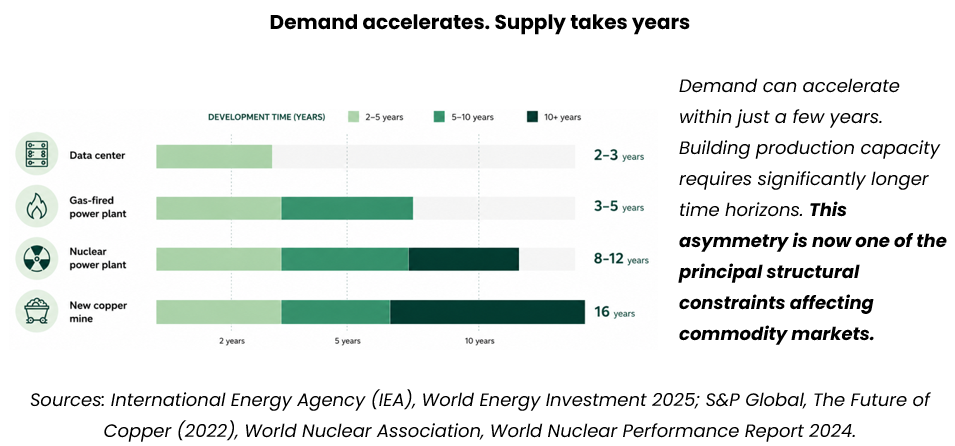
Copper is probably the most emblematic example. Demand growth is supported by structural drivers—electricity grids, electric mobility, data centres and infrastructure—but it is supply that faces the greatest limitations. Major mines are, on average, becoming more mature, ore grades are declining and bringing new projects into production can easily take more than a decade. It is therefore unsurprising that many mining companies prefer to acquire existing deposits rather than develop new ones. This choice reflects not only financial considerations, but also the increasing difficulty of expanding production capacity rapidly. According to S&P Global, the average time required to bring a new mine from discovery to production now exceeds 16 years[3], highlighting how difficult it is to increase supply quickly, even when prices are high and demand is growing. The IEA also estimates that, under a scenario in which climate targets are fully implemented, copper demand could increase by more than 40% by 2040[4], while the development of new mining projects continues at a significantly slower pace.
A similar dynamic is also affecting the uranium market. The return of nuclear power to the energy debate is no longer linked exclusively to decarbonisation objectives. It increasingly reflects the need to ensure stable electricity generation in an environment of growing demand. The United States, China, India and a number of European countries are reassessing the role of nuclear energy as an essential component of a more resilient electricity system. However, here too, expanding production requires long lead times, significant capital allocation and planning horizons measured in years rather than quarters.
Despite belonging to fundamentally different markets, oil, copper and uranium therefore share the same characteristic: the availability of natural resources is not the main limitation. The real constraint is the ability to transform those resources into production through investment, infrastructure and industrial capacity.
This observation also fundamentally changes the way in which the commodity cycle should be interpreted. Rather than entering a period of scarcity caused by geopolitical shocks, we may be at the beginning of a cycle in which the determining factor will be the reconstruction of production capacity following years of insufficient investment. In other words, the new scarcity concerns industrial capital far more than natural resources.
Artificial Intelligence and the Return of Real Assets
If industrial capacity represents the structural theme affecting commodities, artificial intelligence may amplify its importance even further.
For years, we imagined the digital economy as an alternative to the physical economy. Artificial intelligence demonstrates instead that the two are inseparable. The more computing capacity increases, the greater the need for energy, grids, metals and infrastructure. The digital revolution does not replace industrial capital; it increases its strategic value.
Every new AI model requires greater computing capacity and, consequently, increasingly complex infrastructure. Behind every data centre lies a substantial need for electricity, transmission grids, transformers, cooling systems and industrial materials. The growth of the digital economy generates growth in the real economy, because every increase in processing capacity requires an expansion of production across the entire energy and industrial value chain.
For many years, the energy transition was interpreted as a process of substitution: fewer fossil fuels and more renewable energy; a smaller physical economy and a larger digital economy. The reality appears more complex. Technological transformation does not eliminate the need for real assets. Instead, it changes their role and makes them even more strategic. The challenge is not merely to produce low-emission energy, but to ensure that sufficient capacity is available to support consumption that is expected to grow for many years.
This is probably the change that markets have underestimated the most. Artificial intelligence does not merely represent a technological revolution; it also marks the beginning of a new phase of industrial development. Power plants, mines, transmission grids and infrastructure are therefore returning to a central position, because without them, the growth of the digital economy would simply not be possible.
The Next Cycle Will Be Driven by Investment
Commodities have always accompanied major economic transformations. In the new environment, however, their role is changing. While the market has focused primarily on geopolitical shocks and fluctuations in demand in recent years, the next cycle could be determined by a different factor: the ability to invest rapidly enough to support an economy that is becoming increasingly energy-intensive and infrastructure-dependent.
For investors, this requires a change in perspective. Rather than attempting to anticipate short-term price movements, it will become increasingly important to identify the companies with the expertise, capital and execution capabilities required to benefit from this new phase of investment. Value may shift from access to resources towards the ability to develop them, rewarding business models capable of combining industrial expertise, financial discipline and execution capabilities.
Rather than a new commodity supercycle, the next cycle will be an industrial investment cycle. For many years, investors asked which commodities would become obsolete in the digital economy. Today, the question has been reversed: which raw materials will be essential to make the digital economy possible? This is likely to be the question that defines the next investment cycle.
[1] Source: IEA – Energy and AI (2025)
[2] Source: IEA – Oil Market Report (2025)
[3] Source: S&P Global, The Future of Copper (2022)
[4] Source: IEA, Global Critical Minerals Outlook 2024
Disclaimer
This analysis relates to Plenisfer Investments SGR S.p.A. (“Plenisfer Investments”) and does not constitute a marketing communication relating to a fund, an investment product or investment services in your country. This document does not constitute an offer or invitation to sell or purchase securities or any assets or businesses described herein and does not form the basis of any contract. Any opinions or forecasts provided are as of the specified date, are subject to change without notice, do not predict future results and do not constitute a recommendation or offer of any investment product or service. Past performance is not indicative of future returns. There can be no guarantee that any investment objective will be achieved or that capital will be returned. This analysis is intended exclusively for professional investors in Italy pursuant to Directive 2014/65/EU on markets in financial instruments (MiFID). It is not intended for retail investors or U.S. Persons, as defined in Regulation S of the United States Securities Act of 1933, as amended. Information is provided by Plenisfer Investments, authorised as a UCITS management company in Italy and regulated by the Bank of Italy – Via Niccolò Machiavelli 4, Trieste, 34132, Italy – CM: 15404 – LEI: 984500E9CB9BBCE3E272. All data used in this analysis, unless otherwise stated, are provided by Plenisfer Investments. This material and its contents may not be reproduced or distributed, in whole or in part, without the express written consent of Plenisfer Investments.
Plenisfer Investments SGR S.p.A.
Via Niccolò Machiavelli 4
34132 Trieste (TS)
Via Sant'Andrea 10/A, 20121 Milano (MI)
info@plenisfer.com
+39 02 0064 4000
Contact us at info@plenisfer.com

Tax ID: IT 01328320328
Belonging to Generali Italian VAT group: 01333550323
Registered to The National Compensation Fund
This is a marketing communication. Please refer to the Prospectus and Key Investor Information Document (KIID/KID) before making any final investment decisions. Past performance is no indication of future performance.
The value of your investment and the return on it can go down as well as up and, on redemption, you may receive less than you originally invested.
© Copyright Plenisfer Investments onwards 2020. Designed by Creative Bulls. All rights reserved.