


Stefan Benedetti, Senior Portfolio Manager Distressed, High Yield Debt, Plenisfer Investments SGR
For many investors, emerging market debt remains synonymous with higher risk. Ratings are lower, volatility is higher, and political uncertainty often dominates the headlines.
This perception fails to reflect a far more nuanced reality: emerging markets are not a homogeneous asset class, and credit ratings do not always reflect the true underlying risk of an investment.
As global investors navigate a world shaped by geopolitical fragmentation, uncertainty and diverging economic cycles, emerging markets can offer select opportunities for active investors willing to look beyond benchmarks and ratings alone.
The emerging markets paradox
There is a key difference between the sovereign debt of developed and emerging economies, namely how that debt is funded. Most developed countries borrow primarily in their own currency. Emerging economies, by contrast, often rely on debt issued in foreign currencies, particularly US dollars. This distinction has profound implications.
When inflation rises in the United States and the Federal Reserve tightens monetary policy, the impact on the sustainability of US debt is often mitigated by stronger nominal GDP growth. For many emerging economies, however, higher US interest rates increase debt servicing costs without generating a corresponding increase in domestic growth. This dynamic explains why emerging market sovereign bonds are often perceived as riskier than developed economies with significantly higher debt-to-GDP ratios. Risk is not always the level of indebtedness: it is often the structure of that debt and the country's ability to generate hard-currency revenues.
These revenues can fluctuate significantly, depending on the cycles of commodities, to which these countries are particularly exposed. Energy exporters such as Angola benefit from rising oil prices, while importers such as Egypt or Pakistan face a deterioration in their external balances.
Understanding these differences is essential when selecting the securities to focus on within a universe as complex as emerging markets, where opportunities are rarely found by tracking indices or relying solely on ratings, which are often only the starting point of the analysis.
And some of the best opportunities for active managers arise when the market mistakes a country's reputation for the creditworthiness of a company
Good companies in “bad” countries
Many emerging market companies are fundamentally stronger than the countries in which they operate. They are often market leaders, strategically important to their domestic economies and run by teams accustomed to operating in less predictable environments. Yet corporate ratings often mirror sovereign ones, effectively capping a company's rating regardless of its individual credit profile.
This creates a disconnect between perceived and actual risk: bonds issued by solid companies can carry spreads that imply far greater risk than their underlying fundamentals would justify, since the market often prices the country rather than the company. This phenomenon creates what we consider one of the most attractive segments of the emerging market opportunity set: good companies in bad countries.
The same logic applies to selected distressed situations. In emerging markets, market dislocations often reflect temporary liquidity stress, political uncertainty or excessive pessimism rather than a permanent impairment of value. The ability to identify these situations requires deep fundamental analysis and a willingness to challenge consensus assumptions.
Even macro analysis follows distinctive logic, and Egypt offers a useful example. A purely macroeconomic assessment might suggest a high probability of debt restructuring. A broader geopolitical analysis, however, highlights the country's strategic importance for regional stability and the strong incentives for the Gulf States to provide financial support. In this case, geopolitical analysis proves as important as economic analysis.
Which opportunities today?
After a strong repricing across much of the emerging market universe, opportunities are less abundant than twelve months ago. This does not mean the opportunity set has disappeared. It simply means that selectivity matters more than ever.
At the sector level, we are looking at potential distressed opportunities in areas hit by geopolitical tensions, such as in aviation. Higher fuel costs, weaker demand on some routes and the persistent airspace restrictions linked to conflicts in the Middle East have put pressure on parts of the industry. In this sector, aircraft leasing companies, for example, will be worth monitoring, as their assets retain long-term strategic value despite short-term market stress.
Within the energy sector, we continue to see value in selected oilfield services, refining and infrastructure companies in South America and East Africa, regions that benefit from growing investment flows while facing less direct competition from Middle Eastern and Russian producers.
Geographically, Latam still represents the area with the highest density of credit opportunities. The path begun by Venezuela to re-engage with international financial institutions could offer new opportunities in debt restructuring processes; in Brazil and Mexico we expect refinancing or debt restructuring processes to begin among companies operating in the mining sector; in Argentina we are watching the energy sector closely. Colombia represents a different kind of opportunity. The presidential election cycle is creating volatility and uncertainty, but we see limited restructuring risk. Political developments could continue to generate market fluctuations in the short term, but they could also create attractive entry points for long-term investors.
There is no shortage of opportunities in other areas either, for example in the corporate space in Turkey or in Ukraine: despite the ongoing war, many Ukrainian companies continue to operate effectively, honour their financial obligations and generate solid cash flows. In some cases, valuations still reflect a level of pessimism disconnected from operating reality.
In Africa, Senegal faces significant fiscal challenges and a debt restructuring appears increasingly likely. However, the country's strategic importance within West Africa suggests that any restructuring process could be designed to preserve financial stability and social cohesion, with potentially more favourable outcomes than the current market price implies.
Brazil and the 2026 election cycle
Brazil illustrates many of the complexities - and opportunities - that define emerging markets today. In a world marked by conflict and geopolitical tensions, the country occupies a relatively unique position, immune to the tensions affecting other regions. It is a significant exporter of energy, agricultural products, industrial metals and, increasingly, strategic minerals. It boasts a financial market that is relatively large domestically for an emerging country, allowing the government and companies to fund themselves in local currency, with lower currency risk than most emerging countries.
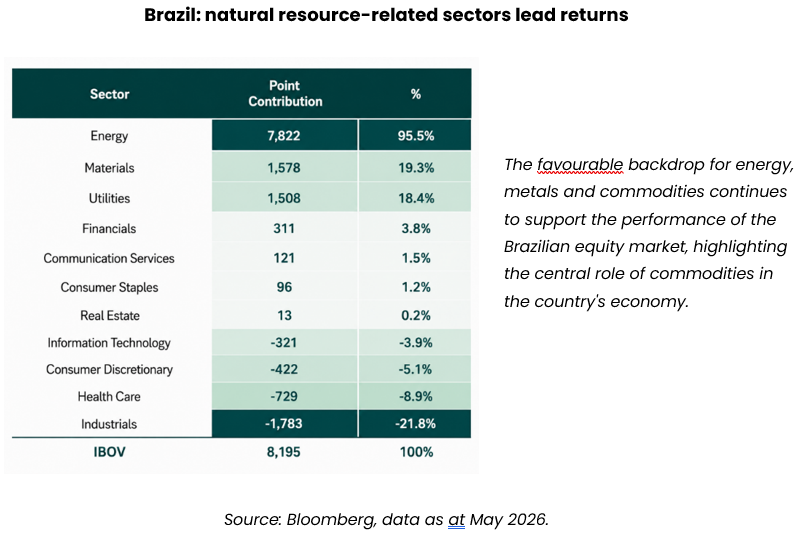
The current commodity cycle is particularly favourable. Higher energy prices support the development of the offshore oil industry, while global efforts to diversify supply chains away from China are creating new opportunities in sectors such as rare earths and critical minerals. It is no surprise that commodity-related sectors have been among the largest contributors to the performance of the Brazilian equity market over the past year. This dynamic is also evident in the Brazilian market's year-to-date performance, where the segments most exposed to commodities have led returns.
On the other hand, political fragmentation continues to complicate economic reforms. Fiscal deficits remain high, public debt is rising, and high real interest rates - around 10% - continue to weigh on domestic growth, expected to be below 2% for 2026[1].
The Brazilian economy increasingly reflects two parallel realities: a globally competitive export sector that benefits from favourable external conditions, and a domestic economy constrained by structural inefficiencies and fiscal pressures.
This context makes the presidential elections on 4 October particularly important.
At present, incumbent president Lula remains the most likely candidate for the progressive front, just as Senator Flavio Bolsonaro is on the conservative side. Polls indicate an open and highly polarised race. If Lula secures a new mandate, substantial continuity in economic and social policies is likely. On the opposing side, a victory by a candidate backed by the Bolsonarist camp could lead to a more market- and privatisation-oriented agenda.
For investors, however, the central theme will not be so much the winner as the next president's ability to build stable parliamentary majorities in a country where whoever wins must govern with almost half the population doubting the legitimacy of the vote. And it is precisely this limited capacity to act that continues to be the main brake on Brazil's long-term growth potential, even more than the election outcome itself. Healing this divide and modernising the country through structural reforms will be the real challenge for the new President.
For investors, however, political uncertainty does not necessarily equate to investment risk. In many cases, it creates opportunities for active managers able to distinguish short-term noise from long-term fundamentals.
Variety, dispersion and inefficiencies: an opportunity for active managers
The growing dispersion across emerging markets reinforces a simple conclusion: passive approaches are increasingly ill-suited to address them. Performance drivers vary considerably across countries and issuers. Commodity exposure, fiscal policy, monetary dynamics, geopolitical alliances, electoral cycles and corporate governance are all relevant. The challenge and the opportunity lie in understanding how these factors interact.
This is particularly true in today's environment, where global fragmentation is creating both winners and losers in the emerging world. Some sovereign issuers are benefiting from stronger commodity prices and strategic geopolitical positioning. Some distressed credits trade at valuations that already price in overly negative outcomes. And many high-quality corporate issuers continue to offer attractive yields because investors remain focused on sovereign ratings rather than on company fundamentals.
For active investors, these inefficiencies represent a valuable source of potential return.
[1] Source: Bloomberg
Disclaimer
This analysis relates to Plenisfer Investments SGR S.p.A. (“Plenisfer Investments”) and does not constitute a marketing communication relating to a fund, an investment product or investment services in your country. This document does not constitute an offer or invitation to sell or purchase securities or any assets or businesses described herein and does not form the basis of any contract. Any opinions or forecasts provided are as of the specified date, are subject to change without notice, do not predict future results and do not constitute a recommendation or offer of any investment product or service. Past performance is not indicative of future returns. There can be no guarantee that any investment objective will be achieved or that capital will be returned. This analysis is intended exclusively for professional investors in Italy pursuant to Directive 2014/65/EU on markets in financial instruments (MiFID). It is not intended for retail investors or U.S. Persons, as defined in Regulation S of the United States Securities Act of 1933, as amended. Information is provided by Plenisfer Investments, authorised as a UCITS management company in Italy and regulated by the Bank of Italy – Via Niccolò Machiavelli 4, Trieste, 34132, Italy – CM: 15404 – LEI: 984500E9CB9BBCE3E272. All data used in this analysis, unless otherwise stated, are provided by Plenisfer Investments. This material and its contents may not be reproduced or distributed, in whole or in part, without the express written consent of Plenisfer Investments.
Plenisfer Investments SGR S.p.A.
Via Niccolò Machiavelli 4
34132 Trieste (TS)
Via Sant'Andrea 10/A, 20121 Milano (MI)
info@plenisfer.com
+39 02 0064 4000
Contact us at info@plenisfer.com

VAT n. & Tax ID: IT 01328320328
Belonging to Generali Italian VAT group: 01333550323
Registered to The National Compensation Fund
This is a marketing communication. Please refer to the Prospectus and Key Investor Information Document (KIID/KID) before making any final investment decisions. Past performance is no indication of future performance. Past performance is no indication of future performance.
The value of your investment and the return on it can go down as well as up and, on redemption, you may receive less than you originally invested.
© Copyright Plenisfer Investments onwards 2020. Designed by Creative Bulls. All rights reserved.